






Deploy Your Gifts
Walking in Spiritual Gifts
1 Peter 4:10-11; Romans 12:3-8
Recurrent Thought
Spiritual Gifts like any form of abilities or skills are only useful when deployed.
One thing that is clear in scripture is that the ministry we offer both to the Lord and to the world is Gift centered and driven. It is essential to discover and eventually deploy your gifts.
Therefore, Giftings are only meaningful when they are deployed. Discovery and labelling of our gifts are never beneficial in themselves if we do not ultimately deploy them for service. What then are Spiritual Gifts? Spiritual Gifts are those capacities that become part of us when we undergo a spiritual encounter. Some start developing when we become born again, Spirit baptized, we have spiritual and prophetic encounters. Spiritual Gifts (abilities) are the avenues through which we deliver service to others
1Pe 4:3 For the time that is past suffices for doing what the Gentiles want to do, living in sensuality, passions, drunkenness, orgies, drinking parties, and lawless idolatry.
1Pe 4:4 With respect to this they are surprised when you do not join them in the same flood of debauchery, and they malign you;
Today, we want to glean instructions and wisdom from the list of Gifts found in Romans 12:3-8. Take note that the three Pauline lists include 1 Cor. 12:1-11 known as Spiritual or Manifestational Gifts, and Eph. 4:7-14 known as Ministerial Gifts and Romans 12:3-8 known as Motivational Gifts.
Four Main Points on understanding and deploying our gifts
1.Nature of Motivational Gifts (Romans 12:3–8)
- Why are these called Motivational Gifts?
- They are called Motivational Gifts because they describe the recurring ways believers naturally perceive situations, respond to needs, and serve within the body of Christ. They are also called Functional Gifts because each believer has a distinct function that benefits the whole body.
- Every born-again believer, born of the Spirit of God, receives spiritual graces for service. Spiritual gifts originate with God, not with human ability.
- 1Pe 4:10 As each has received a gift, use it to serve one another, as good stewards of God's varied grace:
- As you discover and develop them, these gifts become the inner drive and influence how you naturally respond to ministry opportunities and needs. Your gift often reveals where God wants to use you.
- These Gifts entrench a permanent wiring for life and shaping one’s unique disposition (personality) of service. Long term, these Spiritual gifts strongly influence your ministry persuasions.
- These gifts become life lenses helping believers recognize particular needs and opportunities that others may overlook. They position you to see situations from a specific vantage point. What others may overlook, your gift may help you see.
- Spiritual gifts require discovery, development, and deployment. We must discover how God has gifted us, develop those gifts through maturity, and use them faithfully. A gift unused is a grace unexpressed.
- Faithfully using Your gifts brings joy and satisfaction because You are serving according to God's gracious enablement. There is joy in serving where God has gifted you.
- Every gift is ultimately given for the common good and the growth of the church. When believers faithfully use their gifts, the whole body benefits from God's grace.
- Rom 12:4 For as in one body we have many members, and the members do not all have the same function,
- Your gift is not primarily for you; it is for the body. Spiritual gifts come from God and therefore, the glory from them belongs to God.
2. The Relationship Between Spiritual Gifts and Virtue
- Spiritual gifts are closely connected to virtues that every Christian should practice. All believers are called to Practices in some measure. For example, all believers are to serve, show mercy, give, and exhort others.
- One with a Spirit-enabled spiritual gift is not easily deterred and operates with a Spirit-given ease.
- Furthermore, motivational Spiritual gift provides Unusual joy and fruitfulness to the believer operating in them. The believer finds special delight and satisfaction in serving in that area; others are genuinely helped and strengthened through that ministry A gift is not merely a natural ability used in the church.
3.Parameters (Context) of Spiritual Gifts (12:3-5)
Context Insights
Gifts Generated by God’s Grace
- Spiritual gifts are a gracious bestowment from God (12:3). They are grace-centered, not earned. However, you are required to develop them after being given through Grace
- They are better exercised through humility (12:3)
- Gifts are most effective when exercised by a humble character. Those who communicate God’s grace effectively do not think too highly of themselves; they keep pride under control.
- They demand you to apply faith in Implementing them
- Gifts must be exercised in faith, according to the measure of faith God has given (12:3).
- Recognize diversity and uniqueness
- God gives different gifts to different believers (12:6). We should not compare ourselves with others or try to become like our neighbors. The three lists of Gifts use the Human body as an illustration on the operations of Gifts. They show that there different gifts, one body, yet one purpose.
- They are only beneficial when used
- Spiritual gifts benefit the body of Christ only when they are faithfully exercised (12:6). A gift discovered but never deployed is grace left unexpressed
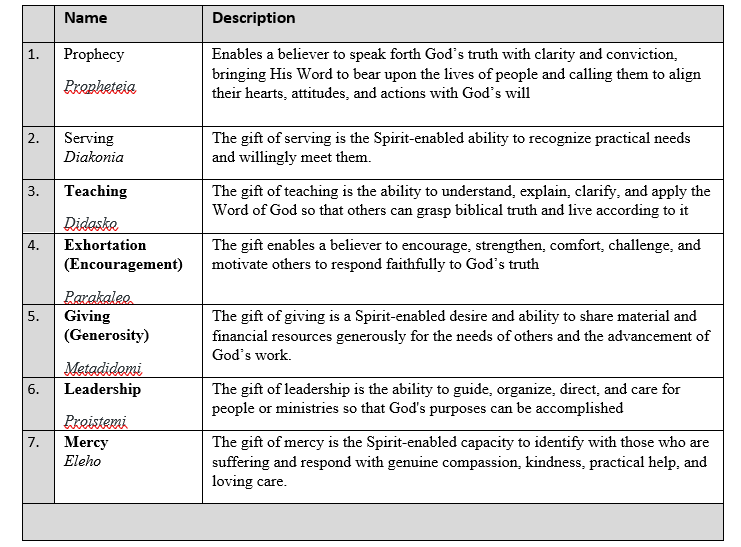
4.A Scan of the Seven Spiritual Gifts Romans 12:6–8
- Prophecy
- The gift of prophecy enables a believer to speak forth God’s truth with clarity and conviction, bringing His Word to bear upon the lives of people and calling them to align their hearts, attitudes, and actions with God’s will. Prophecy in its essence has a niche to On the other hand, the one who prophesies speaks to people for their up building and encouragement and consolation (1Cor. 14:3 ). Paul emphasizes that prophecy must operate according to the measure of faith. This description is critical for it shows that the prophet does not speak to impress people; he speaks to align people with God.
- Serving:
- The gift of serving is the Spirit-enabled ability to recognize practical needs and willingly meet them. It expresses itself through humble, hands-on ministry—helping people, supporting the work of the church, and doing what needs to be done without seeking recognition.
- Some people preach with their mouths; servants preach with their hands.
- Teaching:
The gift of teaching is the ability to understand, explain, clarify, and apply the Word of God so that others can grasp biblical truth and live according to it. The teacher takes what may be difficult to understand and makes it clear enough to obey. Teaching makes Truth Understandable. For believers, teaching is that skill that turns biblical truth into understandable and livable truth. - Exhortation (Encouragement)
The gift of exhortation enables a believer to encourage, strengthen, comfort, challenge, and motivate others to respond faithfully to God’s truth. The exhorter does not merely tell people what is right; he helps them take the next step toward obedience. Exhortation does not merely encourage the weary; it calls the believer forward. It encourages believer move toward God - Giving
The gift of giving is a Spirit-enabled desire and ability to share material and financial resources generously for the needs of others and the advancement of God’s work. The Gift of Giving (Generosity) ensures to release resources for God’s Work. Paul emphasizes that this giving is to be done with simplicity—without selfishness, manipulation, or a desire for applause. - The gift of giving sees what God has placed in my hands as something God can use.
- Leadership
The gift of leadership is the ability to guide, organize, direct, and care for people or ministries so that God's purposes can be accomplished effectively. Biblical leadership is not about controlling people; it is about faithfully taking responsibility and diligently moving people toward a God-honoring goal. The Greek word stands for a helmsman, one who guides and directs a ship. Leadership is guiding others with diligence. Biblical leadership is not about standing above people, but taking responsibility for people. - Mercy
The gift of mercy is the Spirit-enabled capacity to identify with those who are suffering and respond with genuine compassion, kindness, practical help, and loving care. Mercy is about caring for the hurting. Paul specifically says that mercy should be exercised with cheerfulness, not reluctantly or merely out of obligation. Mercy does not merely see suffering; mercy moves toward the suffering.
5. Three Key Observations on the Gifts
- Before closing the Discussion let’s make three Observations
- The Gifts Are Different, But the Grace Is the Same
- “Having then gifts differing according to the grace that is given to us…” Romans 12:6, KJV
- Paul recognizes genuine diversity among believers. Not everyone serves in exactly the same way.
- At the same time, the gifts come from “the grace that is given to us.” The emphasis is therefore not on personal achievement but on divine enablement. Diversity of function does not mean superiority of one gift over another. A church should not measure spiritual value by visibility, position, or public recognition. The same grace of God is working through different ministries.
- The Gifts Overlap in their Functions
- A particularly important observation is that these gifts should not be treated as seven completely sealed compartments.
- Prophecy can contain exhortation.
- Teaching can include exhortation.
- Giving can involve mercy.
- Service can involve mercy.
- Leadership can require teaching and exhortation.
- The distinction is therefore primarily in function and emphasis, not necessarily in completely separate activities. This agrees with the broader principle found in the teaching material on spiritual gifts: Scripture speaks of diversity of gifts and ministries while emphasizing the same divine source and the common good. Therefore, Romans 12:6–8 should not be used to create rigid categories that Scripture itself does not create. Different functions may serve the same purpose.
- Don’t Just Discover but Deploy It
- Notice the repeated movement of the passage:
- If prophecy, then prophesy
- If ministry, then minister
- If teaching, then teach
- If exhortation, then exhort
- If giving, then give
- If leading, then lead
- If mercy, then show mercy
- Paul's concern is not merely, “What is your gift?” but “How are you using what God has given?” This fits the homiletical principle that the biblical text should provide the central truth and lead toward practical application rather than merely supplying information. Spiritual gifts are given for ministry, not merely for identification. A gift discovered but never exercised does not fulfill its purpose.
Conclusion
The Gifts are supposed to bless the Local Assembly and the Kingdom of God ultimately. But they are only useful, when they are deployed. How do you do this? Just start, do it by Faith (12:3; 6)
Altar Time
-
Prayer for Discovery
- “Lord, help me to recognize and understand the gifts You have graciously given me, and remove every confusion, comparison, or fear that keeps me from seeing where You want me to serve.”
-
Prayer for Development
- “Lord, give me humility, faith, wisdom, and discipline to develop the gifts You have entrusted to me, so that I may serve according to Your grace and not according to pride or self-interest.”
-
Prayer for Deployment
- “Lord, move me from merely knowing my gifts to faithfully using them. Give me courage to start, willingness to serve, and grace to use what You have given me for the blessing of others, the growth of the Church, and the glory of Your name.”
Discussion Questions for Cell System
- Why are spiritual gifts only truly meaningful when they are deployed in service to others?
- How can humility and faith help us use our spiritual gifts effectively?
- Which of the seven gifts in Romans 12:6–8 do you most clearly recognize in your life, and how could you use it to bless the church?
- What can prevent a believer from moving from discovering a spiritual gift to actually deploying it?