






Understanding Manifestation Gifts
Walking in Spiritual Gifts
James 1:17; 1 Peter 4:10–11; 1 Corinthians 12:1–27
Recurrent Thought
Believers are expected to Yield to the Holy Spirit and minister to others, in the Body of Christ, through their Spiritual Gifts
As a community, a local church ministers to itself through the efforts of its members. This effort is expressed through the capacities, the spiritual gifts, that God endows to each of them. Gifts (Resources) are the abilities members use as they minister to one another. What is a Spiritual Gift?
A Spiritual Gift is a special, supernatural ability or empowerment given by the Holy Spirit to believer to serve others and build up the Church (1 Peter 4:10–11; Rom. 12:6–8). God bestows these gifts to the Church so that believers may support each other, and thereby the community grows.
The Three Pauline Lists of Spiritual Gifts
From the Pauline Epistles, we encounter three lists of Spiritual Gifts, each called by a different name:
- Motivational Gifts are the integral grace-bestowments the Holy Spirit deposits in every Christ-devoted follower at their spiritual birth (1 Peter 4:10–11; Rom. 12:6–8). They shape one's life perceptions and inclinations on the journey toward their destiny. As a believer grows in Christ, these gifts become an increasingly formative part of who they are.
- Ministerial Gifts are the specific strengths, leadership roles, and offices Christ gives to the church to equip, train, and mature the body of believers (Eph. 4:11–14). These are gifts of persons, typically functioning to lead and shepherd the varied geographical expressions of the Kingdom of God. Through these gifts, Christ ensures His church is continually built up and rightly ordered.
- Manifestation Gifts are Extraordinary, Supernatural manifestations of the Spirit given for immediate, spontaneous and miraculous impact activated through a believer in a specific moment in time (1 Cor. 12:7-11). They function spontaneously, activated by the Spirit as He wills, rather than residing permanently in a person's makeup. Through these gifts, God's immediate power and presence are revealed in the here and now.
This teaching will have three parts
- The nature of Manifestation Gifts Described
- The Workings of the Manifestation Gifts Explained
- The Triggers of Manifestation Gifts Outlined
Part # One: The Nature of Manifestation Gifts Described (1 Corinthians 12:1-11)
1.These are Spiritual Gifts
- The word for "gifts" here is pneumatika. These are not gifts of money, beauty, health, or fame.
- The problem is that many of us are not interested in spiritual things.
- Some say, "We are so heavenly-minded that we are no earthly good." But many Christians are so earthly-minded that they are no heavenly good.
2. These are Supernatural Gifts
- 1 Corinthians 12:4 — The word for "gifts" here is the Greek word charismata.
- Charis is the word for "grace."
- Charismata is also the word from which we get "charismatic."
- A charismata is a grace gift.
- Grace is that which is completely and totally unearned; it is the sovereign, saving, and supernatural work of God.
- A grace gift is different from talent.
- It is not something earned or learned.
- When you have a spiritual gift, there is no room for pride.
3.These are Service Gifts
- 1 Corinthians 12:7 — "to profit withal" means "to profit the others," "to profit the whole body."
- To have a spiritual gift is not a means to an end.
- It is not for our selfishness.
- It is not to make us feel good.
- It is not to prove something to us.
- These gifts are not for evidence; they are equipment.
- These gifts are not for our enjoyment but for our employment.
- God has given us a gift to profit withal.
4. These are Sovereign Gifts
- 1 Cor. 12:11 — We do not decide what gift we will have; the Holy Spirit chooses our gift.
- Our joy and responsibility is to discover the gift God has given us.
- 1 Corinthians 12:31
- This verse does not mean we are to pray for a specific gift.
- Paul is saying that those in the Corinthian church were seeking (coveting) what they thought were the best gifts, such as tongues and miracles.
- This is not an imperative when Paul says, "You covet the best gifts" — it is indicative.
- Paul is in essence saying, "This is what you're doing."
- A spiritual gift is a sovereignly bestowed gift.
- We are not to covet or desire someone else's gift.
- We should thank God for the gift He has given us.
5. These are Support Gifts
- 1 Corinthians 12:17–21 — God has given us different gifts so that He might make us one.
- Each of us has different gifts, and together we must depend upon one another.
- This is what makes the church the church.
- It would not make sense to try to exercise our gift apart from our relationship to the body.
- The hand is significant only as it is part of the body.
- Your spiritual gift is here to support the rest of the body, in order to profit the whole body. We're not to be a "Lone Ranger" Christian (1 Cor. 12:26).
- When one member suffers, every member suffers with it.
- It is sheer pride to say we don't need the church.
- You need the church, and the church needs you.
Having established what Spiritual Gifts are in general — and having distinguished Motivational, Ministerial, and Manifestation Gifts as the three biblical categories — we now turn to the heart of this teaching: the Manifestation Gifts themselves, as detailed in 1 Corinthians 12:8–10.
Part # Two: The Workings of Manifestational Gifts Explained
- The text introduces nine Manifestational Gifts
- Grouping Gifts based on the word “another”
- The text categorizes the gifts based on their type and some believe this grouping also reflects the level of spiritual energy or intensity required for their operation. The key to spotting these categories is the word Paul uses for "another." In Greek, there are two primary words for "another":
- Allos — another of the same kind
- Heteros — another of a different kind
- The distinction matters. When Jesus said, "I will send another Comforter" (John 14:16), He used allos; meaning another Helper of the very same kind as Himself, not a lesser or different substitute. In 1 Corinthians 12:8–10, Paul uses this same distinction to structure the nine manifestation gifts into three groups: 2, 5, and 2. He uses heteros to mark the transition between groups (signaling a different category), while using allos within each group (signaling gifts of the same kind or class).
- Grouping of Gifts based on their manifestation
- The List can be viewed in three ways: Gifts that Reveal, Gifts that do something, and Gifts that utter (say) something
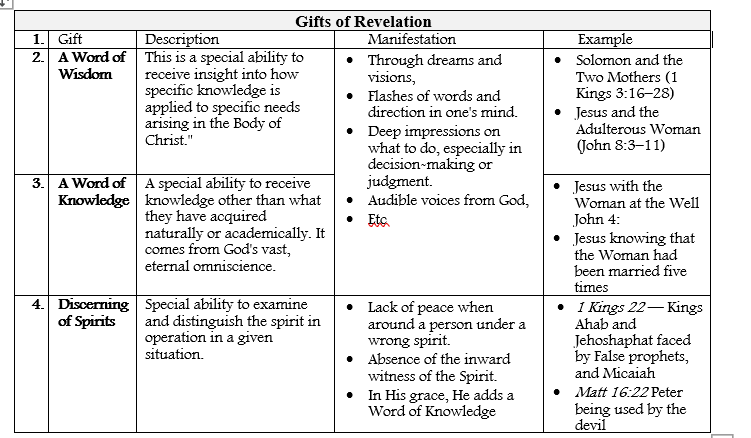
- The Gifts of Revelation include: The Gift of A word of Wisdom, A Word of Knowledge and Discerning of Spirits.
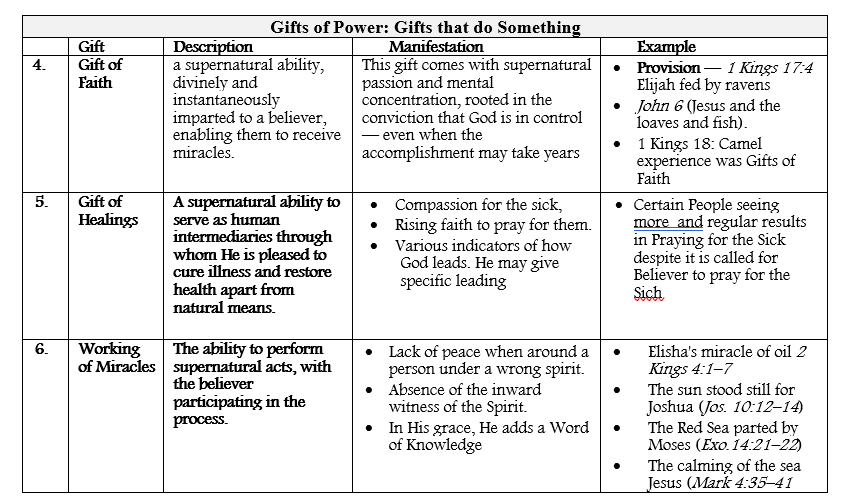
- The Gifts of Power include: The Gift of Faith, The Gift of Healings and the Gift of Working of Miracles
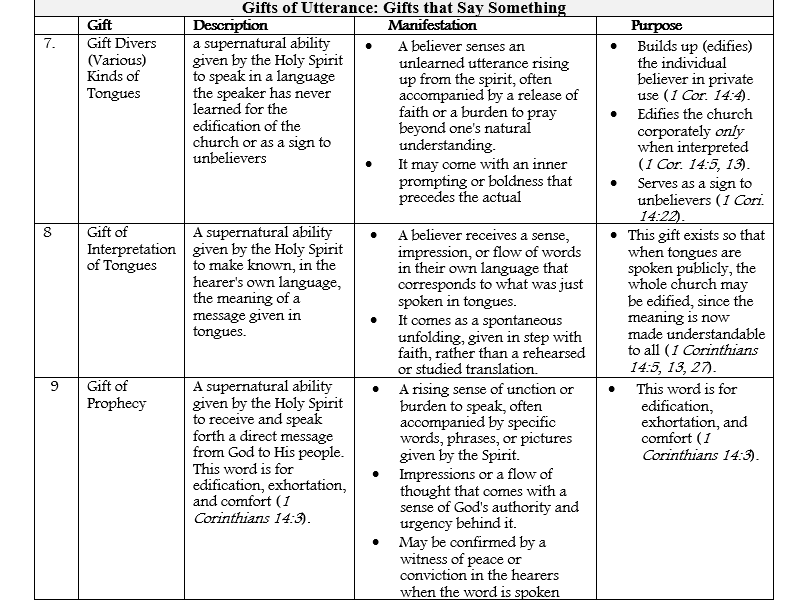
- The Gifts of Utterance include: The Gift of Prophecy, the Gift of Various Kinds of Tongues and the Gift of Interpretation of Tongues
A General Admonition about Manifestation Gifts
To operate in these gifts, we must first develop our spirits: Learn to hear God's Spirit, remain sensitive to His leading, and avoid grieving the Holy Spirit (Eph. 4:30). These are about yieldedness, practice and constant chasing the leading of the Holy Spirit
The Gifts of Revelation: Gifts that see, and reveal Something
1. A Word of Wisdom
- a. What it is NOT
- It is not natural wisdom of an inherent mind.
- It is not wisdom gleaned from studying the Bible.
- It is not wisdom gotten from other supernatural sources (e.g., astrology, mediums, spirits, witchcraft).
- What is Wisdom?
Wisdom is the ability to interpret, discern, judge, and decide using information (knowledge) available or given to someone in a particular situation. - However, Scripture specifies "a word of wisdom" — meaning a portion, not the whole of wisdom.
- We can therefore define it the Gift of a Word of Wisdom as:
- A special ability to receive insight into how specific knowledge is applied to specific needs arising in the Body of Christ."
- c. Manifestation
- Through dreams and visions, giving direction on how to use that knowledge.
- It may appear as flashes of words and direction in one's mind. It may include deep impressions on what to do — especially in decision-making or judgment.
- Audible voices from God.
2. A Word of Knowledge
- This is a special ability to receive knowledge other than what they have acquired naturally or academically. It comes from God's vast, eternal omniscience. He gives just a "word" to edify the Body of Christ, allowing one to know something about another person without being taught. (e.g., Jesus and the woman at the well, John 4.)
- A word of knowledge is not an educated, theological, or "cultured" mind at work — it is revelation.
- Manifestation
- This may come through Visions and dreams, where one knows something without a shadow of doubt. It may include Impressions and flashes in one's mind.
- Admonition: To operate in both of these gifts, we must first develop our spirits — learning to hear God's Spirit, remain sensitive to His leading, and avoid grieving the Holy Spirit (Eph. 4:30).
3. Discerning of Spirits
- Definition
- "Discern" means to examine, to distinguish differences, or to judge between. This gift examines and identifies the spirit in operation in a given situation.
- Note: This is the discerning of spirits, not of persons.
- Three Categories of Spirit in the Universe
- The Spirit of God (the Holy Spirit and holy angels)
- The spirit of the devil (and his fallen angels)
- The spirit of man
- All three are capable of operating in a given situation (e.g., healing). This gift identifies which spirit is in control.
- Manifestation
- You may have a lack of peace when around a person operating under a wrong spirit. It may include an absence of the inward witness of the Spirit. God, in His grace, often couples this gift with a word of knowledge for specific revelation.
- Examples
- 1 Kings 22 — King Ahab of Israel, King Jehoshaphat of Judah, the false prophets, and Micaiah the true prophet. Both sets of prophets prophesied, but under different spirits.
- Matthew 16:22 — Peter, after being used to give a true revelation, is suddenly used by the devil to bring discouragement — but Jesus recognizes it immediately as coming from the enemy.
- Higher Levels of Discernment
- Discerning whether a fellow believer's actions emerge from godly or carnal motives.Distinguishing truth from error even when motives are right.
Gifts of Power: Gifts that do something
4. The Gift of Faith
- a. Definitions: Faith is a strong trust or confidence in someone or something.
- Aspects of Faith
- Natural trust in the material ("rationalism")
- Saving faith — received from God at salvation
- Character faith — under the fruit of the Spirit
- The Gift of Faith
The Gift of Faith is a supernatural ability, divinely and instantaneously imparted to a believer, enabling them to receive miracles. It differs from growing faith, which develops through prayer, meditation, and practice. - The Gift of Faith is a special ability God gives to some members of the Body of Christ to discern, with extraordinary confidence, the will and purpose of God for His work, especially regarding the future. Those who carry this gift operate from rest and calmness, not stress or anxiety.
- Such people often accomplish great things for God e.g., George Müller (orphanages funded by faith-received contributions) and Robert Schuller (building the Crystal Cathedral with 10,000 diamond-shaped glass panels).
- This gift is frequently at the center of miracles and great healing.
- Accomplishment in the Future
The Gift of Faith empowers certain people to "remove mountains" in God's work. They believe God for a project and see it accomplished. Because they feel God Himself is being criticized, they are often irritated by criticism and resistant to systems that hinder growth. These individuals tend to be visionaries, dreamers, or promoters who project into the future. - A Key Temptation: "Gift Projection"
This is the tendency to tell others, "If I can do it, you can too." This creates misery and guilt in believers who read about great men and women of faith but have not identified their own gifting. - Manifestation
This gift comes with supernatural passion and mental concentration, rooted in the conviction that God is in control — even when the accomplishment may take years. - Scripture shows the Gift of Faith operating through:
- Provision — 1 Kings 17:4 (Elijah fed by ravens after speaking judgment); John 6 (Jesus and the loaves and fish).
- Preservation — Daniel 6:16 (peace in the lions' den despite no natural remedy — peace is a key signal that faith, not fear, should govern the moment).
- Spiritual Transportation — Genesis 5:24, Hebrews 11:5 (Enoch translated by faith); 1 Kings 18:12 (Elijah operated in this gift with unshakable confidence).
- (Those who walk in this gift are sometimes viewed as "undaunted" or even reckless — but they pursue the goal with unwavering, intense passion.)
5. Gifts of Healing
- Gifts of Healing is a supernatural ability God gives to certain members of the Body of Christ to serve as human intermediaries through whom He is pleased to cure illness and restore health apart from natural means.
- (This gift can be understood as a specialized manifestation of the Gift of Miracles, though Scripture lists it separately.)
- Why "Gifts" is Plural
In the original text, the gift appears in plural form, "Gifts of Healing" implying varieties tied to different kinds of illness (e.g., healing of emotions and past hurts, healing of deafness only, etc.). - Relationship to Medicine
This gift does not stand against medical practitioners or natural remedies. Paul instructs Timothy to "drink a little wine for thy stomach's sake" (1 Timothy 5:23). - Jesus recognized the role of Medicine and Physicians. IN Matthew 9:12 he said: …“Those who are well have no need of a physician, but those who are sick.
- Distinct from Other Healing Ministries
This differs from the general promise in Mark 16 ("believers shall lay hands on the sick, and they shall recover") and from the healing prayer described in James 5. All these operate within the Body of Christ, as gifts to the church. - Manifestation
- It begins with heightened compassion for the sick, followed by rising faith to pray for them.
- There are various indicators of how God leads. He may give specific leading — a tingling sensation or anointing in the hands, or a felt sensation in a particular part of the body as a sign of what to pray for.
- (Example: One Mrs. Chisha at Mulungushi described feeling pain in the chest, stomach, and ankle while at that same moment, people with those exact ailments were being healed.)
- Jesus was mightily used in this gift, and it remains a powerful tool for church growth.
6. The Working of Miracles
- A miracle is a supernatural intervention in the ordinary course of nature; a temporary suspension of the natural order by the power of the Spirit of God.
- The Gift of Working of Miracles is the ability to perform supernatural acts, with the believer participating in the process.
- Examples
- Miracles of Provision (Multiplication of Food)
- Jesus with the fish and bread — Matthew 14:13–21; Mark 6:30–44; Luke 9:10–17; John 6:1–14
- Elisha's miracle of oil — 2 Kings 4:1–7
- Miracles of Holding Nature at Halt
- The sun stood still — Joshua (Joshua 10:12–14)
- The Red Sea parted — Moses (Exodus 14:21–22)
- The calming of the sea — Jesus (Mark 4:35–41; Matthew 8:23–27; Luke 8:22–25)
- c. Manifestation
- The Gift of Faith operates first, giving confidence for the miracle to come. God grants a definite, settled peace ahead of the miracle taking place.
- d. Concluding Admonition (Power Gifts)
- If we are to be used by the Lord in these gifts, we must:
- Believe that God is able to do the extraordinary.
- Make ourselves ready vessels to be used (2 Timothy 2:20–21).
- Be vessels cleansed for noble use.
Gifts of Utterance
These are the remaining gifts on the list. They are gifts that "say something." They have also been among the most widely abused. Possible reasons include:
- They involve the tongue, which is one of the most useful, yet most dangerous, members of the human body.
- They are often the gifts most visibly seen and experienced in charismatic settings.
- They carry lasting effect, since misuse can wrongly direct someone's life or destiny.
- They are an area where personal opinion and subjective interpretation are common.
We begin with tongues and the interpretation of tongues, before addressing prophecy.
7. Diverse Kinds off Tongues
- Tongues are a supernatural ability given by the Holy Spirit to speak in a language the speaker has never learned for the edification of the church or as a sign to unbelievers (1 Corinthians 12:10; 14:2, 4). The language is either a known human language or a Spirit-given "language"
- Two Distinct Expressions
- Tongues as a sign: as on the Day of Pentecost, when the disciples spoke in actual foreign languages understood by hearers from different nations (Acts 2:4–11).
- Tongues as a devotional/prayer language: used privately for personal edification and communion with God (1 Corinthians 14:2, 4, 14–15), or publicly when accompanied by interpretation.
- Purpose
- Builds up (edifies) the individual believer in private use (1 Corinthians 14:4).
- Edifies the church corporately only when interpreted (1 Corinthians 14:5, 13).
- Serves as a sign to unbelievers (1 Corinthians 14:22).
- Order in the Church
- Paul instructs that tongues in a public gathering should be limited (two or three, in turn) and must be accompanied by interpretation, or the speaker should remain silent in the church and speak instead to himself and to God (1 Corinthians 14:27–28).
- Manifestation
- A believer senses an unlearned utterance rising up from the spirit, often accompanied by a release of faith or a burden to pray beyond one's natural understanding.
- It may come with an inner prompting or boldness that precedes the actual speaking.
8. Interpretation of Tongues
- The Gift of Interpretation of Tongues is a supernatural ability given by the Holy Spirit to make known, in the hearer's own language, the meaning of a message given in tongues.
- It is not necessarily a word-for-word translation, but the God-given sense and substance of the message (1 Corinthians 12:10).
-
- Purpose
This gift exists so that when tongues are spoken publicly, the whole church may be edified, since the meaning is now made understandable to all (1 Corinthians 14:5, 13, 27). - Note on Function
- Purpose
- Interpretation is not the same gift as tongues itself, though the same person may operate in both.
- Paul instructs that one who speaks in an (unknown) tongue publicly should pray also for the gift to interpret (1 Corinthians 14:13).
- Manifestation
- A believer receives a sense, impression, or flow of words in their own language that corresponds to what was just spoken in tongues.
- It often comes as a spontaneous unfolding, given in step with faith, rather than a rehearsed or studied translation.
9. Th The Gift of Prophecy
- The Gift of Prophecy is a supernatural ability given by the Holy Spirit to receive and speak forth a direct message from God to His people. This word is for edification, exhortation, and comfort (1 Corinthians 14:3).
- What it is NOT
- It is not the predicting of the future as its primary function (though foretelling can occur, as with Agabus in Acts 11:28 and 21:10–11).
- It is not the same as the office of a prophet, which carries a broader governmental and foretelling role in the church (Ephesians 4:11). All believers may prophesy at times (1 Corinthians 14:31); but not all are called to the office of prophet.
- It is not a substitute for Scripture, and it must always be tested and weighed (1 Corinthians 14:29; 1 Thessalonians 5:20–21).
- Purpose
- "He that prophesieth speaketh unto men to edification, and exhortation, and comfort" (1 Corinthians 14:3). It builds up the church, encourages believers, and brings comfort in specific, timely ways.
- Manifestation
- A rising sense of unction or burden to speak, often accompanied by specific words, phrases, or pictures given by the Spirit.
- Impressions or a flow of thought that comes with a sense of God's authority and urgency behind it.
- May be confirmed by a witness of peace or conviction in the hearers when the word is spoken.
- Safeguards
- Prophecy must be judged/weighed by other mature believers (1 Corinthians 14:29).
- It should align with Scripture and never contradict God's revealed Word.
- Even genuine gifting must operate "according to the proportion of faith" (Romans 12:6) — with humility, not presumption.
Part #Three: You Must Activate the Manifestation of Gifts
Knowing about spiritual gifts is not the same as walking in them. A person can study the gifts, teach on them, even admire those who operate in them, and still never step into what God has placed within. A gift left unused remains a gift, but it never accomplishes its purpose.
A beautiful piano can sit in a room for years, admired but silent, until someone sits down and plays it. God gives spiritual gifts for a purpose. The question isn't "What has God given me?" but "What am I doing with what He's given me?"
1. Earnestly Desire the Gifts
- 1 Corinthians 12:31 — "But covet earnestly the best gifts."
- 1 Corinthians 14:1 — "Follow after charity, and desire spiritual gifts."
- God doesn't call believers to insignificant issues, He calls them to desire to change lives and impact society. But biblical desire isn't selfish ambition; we don't seek gifts to be admired but to glorify Christ and help others. A firefighter doesn't carry water to be praised; he carries it because someone needs rescuing. That's the right posture toward spiritual gifts.
- Application
- Ask boldly: "Lord, use me. Give me what's needed to serve Your people."
- Don't let fear of failure kill your desire.
- Desire gifts for others' benefit, not your own image.
- Desire the gifts — but desire them for Christ's glory and His people's good.
- Desire alone isn't enough, though. You can want to be used by God and still be ineffective if you try to do spiritual work in human strength. The gift must be desired, but the Giver must also be depended upon.
2. Be Yielded to the Holy Spirit
- Ephesians 5:18 — "Be not drunk with wine... but be filled with the Spirit."
- Acts 1:8 — "Ye shall receive power, after that the Holy Ghost is come upon you."
- Acts 4:31 — "They were all filled with the Holy Ghost, and they spake the word of God with boldness."
- Spiritual gifts aren't produced by talent; they flow from God working through yielded believers. Natural ability, education, and personality can impress people; only the Holy Spirit transforms them.
- A lamp can be beautifully made and perfectly assembled, but if it isn't connected to power, it won't give light. The problem is never the lamp — it's the connection.
- God may have placed real ability in you, but that gift only functions as you stay yielded to the Spirit.
- Application
- Cultivate a life of prayer — including praying in the Spirit (1 Cor. 14:15; Jude 20).
- Don't grieve (Eph. 4:30) or quench (1 Thess. 5:19) the Spirit.
- Surrender control — the Spirit distributes gifts "as He will" (1 Cor. 12:11). We are His servants, not the reverse.
- The more completely you yield to the Spirit, the more freely God can work through you.
- Desire and fullness are not the whole picture, though. Eventually, you have to step out.
3. Step Out in Faith
- Romans 12:6 — "Having then gifts differing according to the grace that is given to us."
- 2 Timothy 1:6 — "Stir up the gift of God, which is in thee."
- Paul told Timothy to stir up what had gone inactive. A gift can't be developed by merely thinking about it, or by only watching someone else minister. Eventually, you must step out in faith.
- A swimming coach can explain technique for hours, but at some point the student has to get in the water. There's a difference between knowing about something and actually doing it.
Application
- Start where you are — you don't need a large platform. Encourage, pray for, teach, or serve someone right where God has placed you.
- Exercise the gift with humility, under the discernment and order of the church (1 Cor. 14:29) — gifts aren't above testing and accountability.
- Let yourself grow. You won't get it all right at first, but a preacher grows by preaching, a teacher by teaching, a servant by serving.
- What God gives you must not stay dormant stir it up, step out, and use it for His glory.
Conclusion:
- God has entrusted something to you as a believer for the good of His people. Don't bury it.
G12 Cell Discussion Questions
- What is the difference between Motivational, Ministerial, and Manifestation Gifts? Which one is the focus of this teaching, and why does that distinction matter for how we understand our role in the Body of Christ?
- List All the Nine Manifestation Gifts from 1 Corinthians 12: 8-11). Distinguish and group them based on the textual arrangement of “another” and on their type of manifestation.
- Why does Paul describe spiritual gifts using the Greek word charismata (grace gift) rather than a word for talent or ability? What difference does this make for how we should feel about the gift God has given us — and about the gifts we haven't been given?
- Of the three gift categories — Revelation, Power, and Utterance — which one do you find easiest to recognize operating in your own life, and which do you find hardest to understand or trust? Why?
- The teaching says a gift must be "desired, yielded to, and stepped out in" before it manifests. Which of these three is currently the hardest step for you personally, and what is one practical way you could act on it this week?